
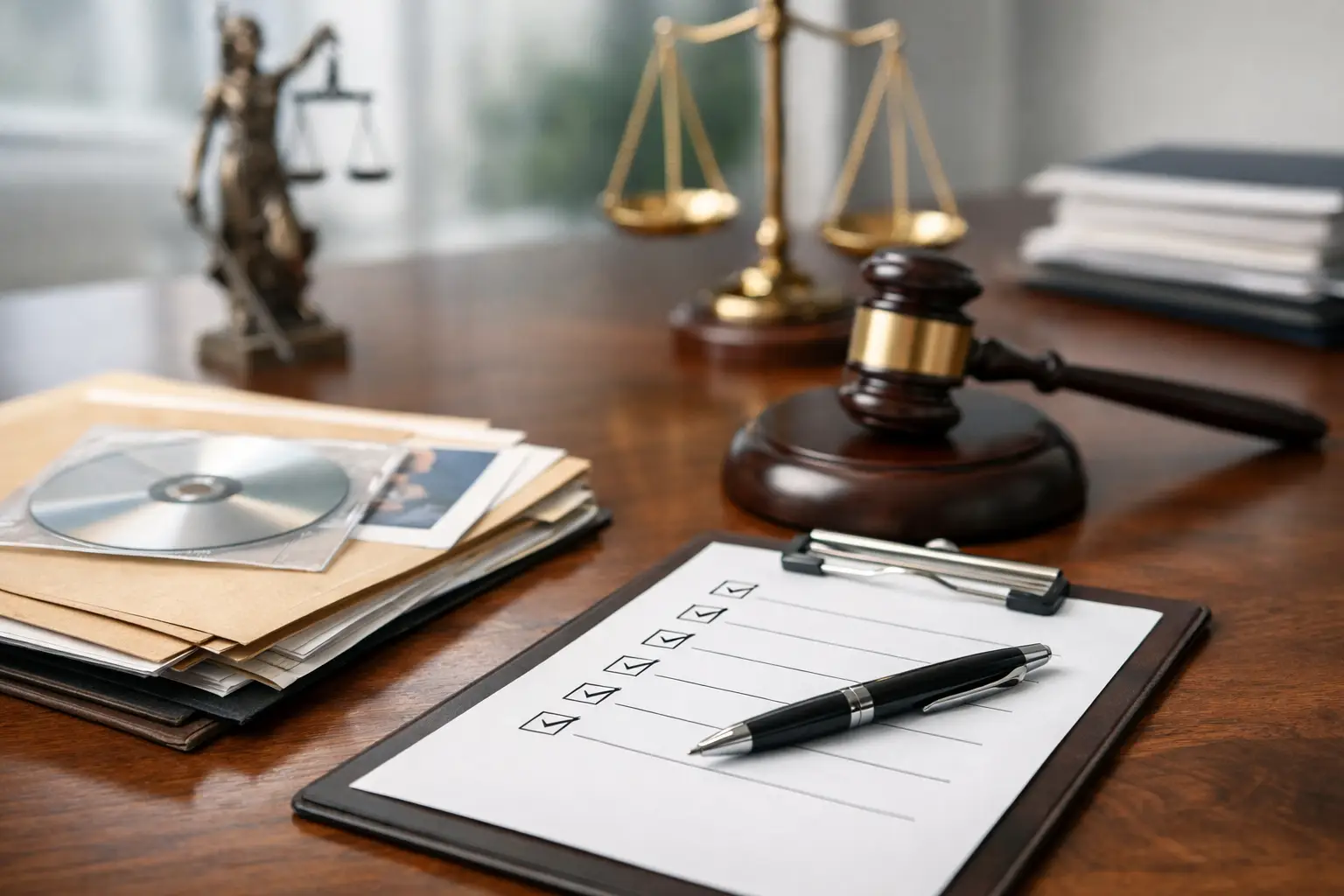
A judge cannot award money based on the fact that you know you were wronged. They need to see the proof: what was agreed, what you did, what the other side failed to do, and how much that failure cost you. A strong court evidence checklist turns a frustrating story into a clear case the judge can follow.
For most small claims cases, the goal is not to bring every message, receipt, and screenshot you have ever collected. The goal is to bring the right proof, organized in the order it answers the judge's questions. That makes your hearing easier, faster, and far more persuasive.
Start With What You Must Prove
Before you print a single document, write down your case in one plain-English sentence. For example: “I completed the landscaping work we agreed on, but the customer did not pay the remaining $1,200 invoice.”
Then break that sentence into the facts you need to prove. In an unpaid debt case, that usually means showing there was an agreement, you held up your end, payment became due, the other party did not pay, and the amount you are asking for is accurate.
Your evidence should support one of those facts. If a document does not help prove your claim, respond to a defense, or calculate your damages, it may only create clutter. Small claims judges often have limited time. Make it easy for them to see the path from agreement to unpaid balance.
Court Evidence Checklist: The Core Documents
The exact documents depend on your dispute, but most claims for unpaid work, loans, deposits, or damaged property start with the same foundation. Gather originals when possible and clear copies for the court and the other side.
- The agreement. This can be a signed contract, estimate, purchase order, invoice accepted by the customer, lease provision, or text messages showing the key terms. Informal agreements can still count. A text saying “Yes, do the work for $800” may be valuable proof.
- Proof you performed or paid. Include completed-work photos, delivery confirmations, time records, signed receipts, bank transfers, canceled checks, or messages where the other party confirms they received the item or service.
- Proof of the unpaid amount. Use invoices, account statements, payment schedules, receipts, and a simple calculation showing the balance. If the defendant made partial payments, show them. Being precise builds credibility.
- Your demand for payment. Bring your demand letter and proof it was sent. Also include follow-up texts, emails, or voicemails asking for payment. These records can show the other side had notice and had an opportunity to resolve the problem before court.
- Communications that tell the story. Save messages where the other party agrees to pay, admits a problem, asks for more time, disputes the amount, or gives a reason for not paying. Do not crop out dates, names, or the surrounding conversation when context matters.
- Evidence of your damages. If you are seeking repair costs, replacement value, a deposit refund, or another measurable loss, bring estimates, receipts, photographs, and records that show how you calculated the number in your claim.
Put Your Evidence in Chronological Order
A pile of good documents can still be hard to use if it is disorganized. Arrange your exhibits from the beginning of the dispute to the end. Start with the agreement, then show performance, the invoice or payment due date, your payment requests, and the current unpaid balance.
Create a one-page timeline for yourself. List the date, what happened, and the exhibit that proves it. For example: “March 3: Defendant approved estimate for $1,200 - Exhibit A.” This is not a replacement for evidence. It is your roadmap when nerves make it hard to remember details.
Label each item clearly: Exhibit A, Exhibit B, Exhibit C, and so on. Add a short description, such as “Exhibit C - Invoice dated April 15.” Keep the labels consistent across your timeline, copies, and hearing notes.
Bring enough paper copies. Many courts expect one set for the judge, one for the other side, and one for you. Some courts have different rules or allow electronic exhibits, so check the instructions on your hearing notice and your local court's website before the hearing. A document that is useful but not provided correctly may be harder to use when it counts.
Make Screenshots and Photos Court-Ready
Digital evidence is common in small claims court, especially when the agreement happened by text or email. But a random collection of screenshots can raise questions: Who sent this? When? Is part of the conversation missing?
For text messages, capture the contact name or phone number, the date and time when available, and enough of the thread to show the exchange honestly. If the relevant message follows a discussion about a different job or payment, include that context. Print screenshots large enough to read without a magnifying glass.
For emails, print the full message with the sender, recipient, date, and subject line. For photos, print color copies if color helps show damage, condition, or completed work. Write a brief caption under each photo identifying what it shows, where it was taken, and when, if you know.
Do not alter messages, edit photos to change what happened, or selectively hide facts that hurt your case. The other side may have the complete record. Credibility is one of your strongest assets in a small claims courtroom, and it is difficult to recover once lost.
Anticipate the Other Side's Best Argument
Do not prepare only for your version of events. Ask yourself what the defendant is likely to say. They may claim the work was incomplete, the item was defective, they already paid, there was no agreement, or you caused the problem.
Then match each likely defense with evidence. If they say the work was poor, bring before-and-after photos, messages approving the work, or proof they used the finished service without complaint. If they claim they paid cash, bring records showing no payment was deposited and messages where they still acknowledge the balance.
This is where relevant witnesses can help. A witness is most useful when they personally saw or heard something important, such as the agreement, delivery, work completed, or damage. A friend who only knows what you told them is usually much less helpful. If you plan to use a witness, make sure they know the hearing date and whether your court requires a subpoena.
Keep Your Claim Amount Simple and Defensible
A judge needs to understand exactly how you reached the dollar amount on your complaint. Use a short damages sheet with basic math. State the original amount owed, subtract payments or credits, then add only costs you are legally allowed to request in your court, such as filing fees or service costs where permitted.
Avoid guessing. If you are claiming property damage, a repair estimate or replacement receipt is stronger than saying, “It looked expensive.” If a contract allows late fees or interest, bring the contract language and calculate the amount carefully. Rules on interest, court costs, and allowable damages vary by state and county, so follow your local court's requirements.
It can also be smart to seek a reasonable amount you can prove rather than stretch for every possible loss. A well-supported $900 claim is often stronger than a vague $2,500 claim filled with assumptions.
Prepare a Two-Minute Explanation
Your evidence does the heavy lifting, but you still need to present it clearly. Practice a short explanation that follows the same order as your exhibits: what you agreed to, what you did or paid, what the other party failed to do, what you requested, and the amount you need the court to award.
Try this structure: “We agreed that I would provide [service/item] for [amount]. I did that on [date], as shown in Exhibit B. Payment was due on [date]. The defendant has paid [amount] or nothing, despite my requests in Exhibits D and E. I am asking for [amount], plus allowable court costs.”
Speak to the judge, not the defendant. Stay calm, answer the question asked, and let your documents fill in the details. You do not need legal language to make a clear case.
Use a System Before You File
Evidence is easiest to organize before filing, not the night before your hearing. A guided preparation process can help you spot missing proof, calculate your claim, and turn scattered records into a court-ready package. Small Claims Genie is built to help you move from “I know they owe me” to organized facts, forms, and evidence you can use.
You do not need a perfect case to take action. You need an honest claim, documents that support it, and a simple way to show the court what happened. Start organizing now, while the details, messages, and receipts are still within reach.